By Sahar Khanloo, Founder Advisor & Growth Consultant, Nxtimpact Consultancy
A founder steps away from a few leadership meetings, expecting the team to take more ownership. Instead, people start skipping the meetings. Decisions aren’t recorded. And the work slows down.
If this sounds familiar, you are not alone.
A few months ago I asked the executive assistant of a founder I work with which of their leadership meetings actually worked.
The company is a services business in Bangalore, around 200 people and growing fast. He said the monthly business development review worked, because the founder gives it his attention.
But the weekly meeting with all the department heads was a different story. When the founder skipped it, other people started skipping it too. Nobody wrote down the decisions. In the HR review, one of the senior leaders had slowly become the chair because the founder stopped coming and somebody had to. Nobody handed it over to him.
Then he showed me the task trackers. Each department head had one, and each tracker was visible to its owner and the founder only. So when the founder travels, nobody knows what is pending in the department next door, and nobody can pick it up.
The founder had started stepping back, but the organisation wasn’t ready to function without his presence.
So how do you scale a business without everything depending on you? My answer, after 20 years in operations and strategy and now working with scale-up founders, is to build the connections that let information and decisions move without passing through you. At the same time, you stay connected to the direction, the culture and the ambition of the company. Stepping back alone doesn’t do it.
What founder dependency is?
Founder dependency is when information and decisions in a growing company can only move through the founder. It rarely comes from a founder who wants control. It happens when the company grows faster than the connections between its people, processes, culture and its systems.
These are the signs I look for when I start working with a founder:
- Every important decision waits for you.
- Meetings stall when you’re away, and projects slow down when you travel.
- Customers only trust you.
- People bring you small decisions they could take themselves.
If two or more of these sound familiar, look at how your company is wired before you look at how hard you work.
The organisational nervous system: how I think about it
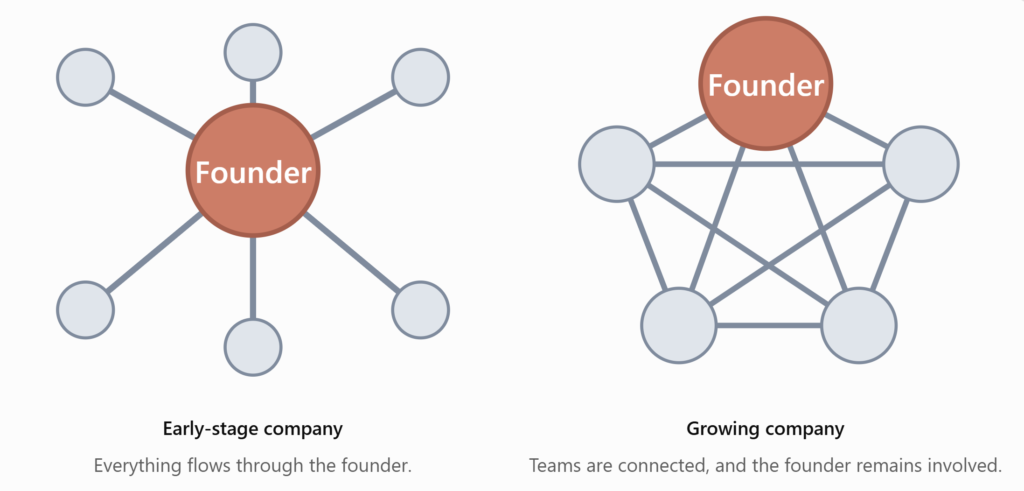
I use a picture with founders that I call the organisational nervous system. It is my own way of explaining how a company holds together as it grows.
Think about how the human nervous system develops. As we grow, new connections form and existing ones evolve, allowing different parts of our body to communicate and function together.
I think companies need to evolve in a similar way.
When you started your company, you were its nervous system. Every customer signal, every problem and every decision passed through you. At ten people that is fast, right? At 150 people the same wiring holds you back, because thousands of signals now wait in line for your attention.
In a company, three things need to grow along with it.
First, leaders need connections to each other, so your head of operations and your head of finance solve a problem together without going through you.
Second, the company needs a rhythm that keeps information moving and problems visible, such as regular reviews with clear owners.
Third, some approvals and meetings need to evolve or disappear, especially the ones that only exist because, once, you needed to see everything.
You stay connected to what matters. You just stop being the connection everything has to pass through.
Why stepping back on its own makes things worse
The usual advice is to delegate more and get out of the way. On its own, I don’t agree with it, and the Bangalore company shows why.
The meetings the founder pulled back from didn’t become more independent. They fell apart. The one he kept showing up to was the one that worked.
Your attention is a signal. People read it as “this matters”.
When you take it away and put nothing in its place, they read that too. Without a clear owner, a rhythm or a decision rule, the work drifts.
I saw the same pattern years ago at Nokia when we expanded into South Africa. The country GM was building a new organisation from scratch, and the customer trusted only him. Every decision went to him because there was no other route. We were brought in to build those routes, so the local operation could run on its own.
So before you step back from something, ask who will carry the signal once you step out. If you can’t answer that, what you are about to create is a gap.
What a founder should still do: form the first connection
As the company grows, the founder’s role moves towards the places where something happens for the first time. You set the standard there and make the link. Then the team carries it.
The same founder in Bangalore told me on one of our calls that he had cut almost half of his regular tasks. In his words: “Only I’m involving myself where something is new and my input is very valuable because it is first time.”
His example was hiring. The company had just introduced a new bar-raising step in interviews, and it wasn’t going well, because the team was rejecting a lot of candidates. So he joined eight to ten interviews himself and showed them what to look for and what not to look for. Once he saw they had got it, he stepped back out.
He now picks one new activity a week. He joins it the first time, maybe the second time, and when it is good enough, he backs off. This is what staying connected looks like at 180 people.
Of course, this doesn’t mean a founder needs to get involved in every new activity. The question is where their experience, judgement or relationships bring unique value — whether that’s setting direction, establishing a new standard, developing people or navigating an important risk.
How information and decisions move without you
Decisions and information move without the founder when there is a rhythm and a clear rule for who decides what. Goodwill between people is not enough to hold the connections.
When we scaled vaccine operations at J&J during COVID, more than 2,000 people were working in shifts, and I had not seen my team in person for months. What held us together was simple. We had daily ten-minute stand-ups on progress, problems and team pulse, and cross-functional reviews twice a week between operations, engineering, quality and R&D. Nobody had to wait for one person to know what was going on.
In growing companies I often see the opposite. Updates happen when the founder asks for them, and decisions made in a corridor never get written down. So the founder also becomes the company’s memory.
In Bangalore the first changes we worked on were small. Make the trackers visible to everyone and flag the few tasks that really are confidential. Give every recurring meeting an owner, an agenda and written actions. And in our leadership workshop in October we agreed that the management team takes the day-to-day decisions within their budgets. The founder keeps what sits above the approval limits, plus anything with a bigger impact or a compliance, risk or reputation angle.
None of this is exciting. It is the wiring that lets a company act as one system when you are not in the room.
Growth, impact and the founder’s evolving role
I see growth as something that starts with the founder and flows through the whole company into the impact it creates. That’s why I often ask founders a question that makes them go quiet. Are you bigger than your mission, or is your mission bigger than you?
If the mission is bigger, the company has to become less dependent on you. Otherwise the impact you want to create can only grow as fast as your calendar.
And for me, that is the bigger reason to develop these connections. It’s not simply about freeing up the founder’s time. It’s about creating a company capable of achieving an ambition that is bigger than one person, with people who can contribute, make decisions and take that ambition further.
A one-week exercise to find your founder dependency
For one week, write down every decision and every piece of information that waited for you in an excel. Then, for each one, ask whether it waited because it really needed you, or because there was no other way.
The first list is your job as a founder. The second list is the system you still have to build.
If you’d like a second pair of eyes on that second list, this is the work I do with founders at Nxtimpact. We usually start with a Founder’s Growth Discovery Day. It’s one focused day about you, your ambitions and where you want your company to go. You leave with a clear plan for the next six to nine months, for your own growth as a founder and for the company’s.
Want to know more about me and how I work with founders? Watch my conversation with Matt Swain, where we talk about helping businesses grow and scale.